
Importance of Engine Oil Change for Your Car: A Complete Guide
Engine oil is often called the lifeblood of a car. Performing a regular engine oil change plays a critical role in keeping your vehicle’s engine running smoothly. An engine oil change lubricates moving parts, reduces friction, carries away heat, and prevents corrosion. Many car owners underestimate the importance of timely engine oil change, which can lead to serious engine damage and expensive repairs.
In this guide, we’ll discuss why engine oil change is essential for every car, the types of engine oil to use, how often an engine oil change should be performed, and additional tips to keep your car in top condition. Following proper engine oil change routines ensures better performance, improved fuel efficiency, and a longer-lasting engine.
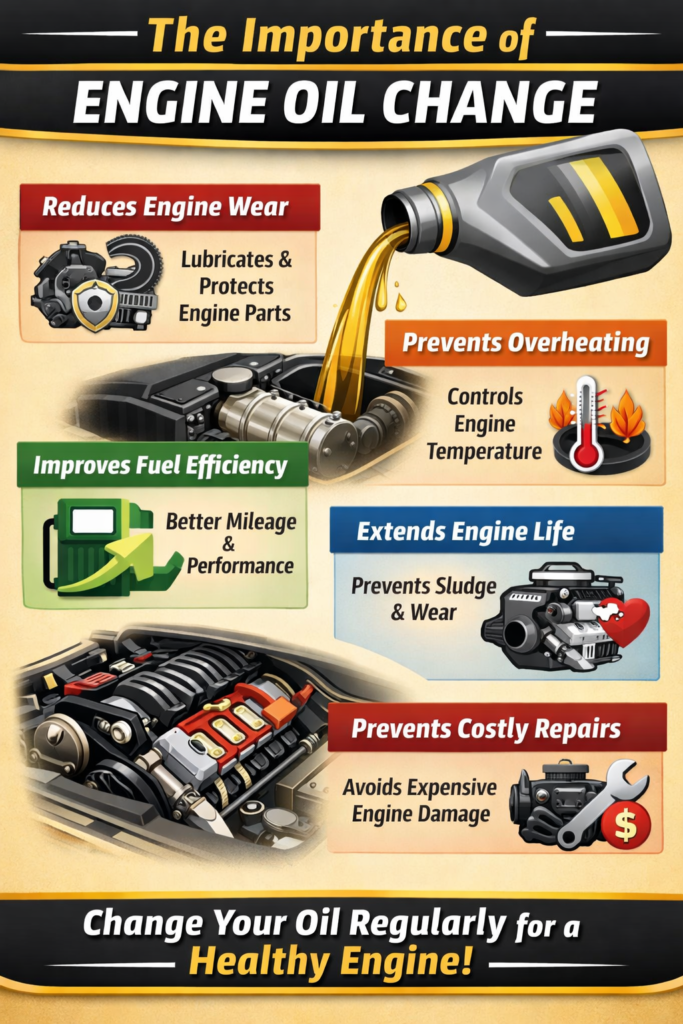
1. Reduces Engine Wear and Tear
Engine components operate at high speeds and temperatures. Without proper lubrication, these metal parts rub against each other, causing friction, heat, and wear. Fresh engine oil creates a protective layer between moving parts, reducing wear and tear.
Dirty or old oil loses its lubricating properties, allowing metal parts to grind together. Over time, this can cause permanent damage and reduce engine lifespan.
2. Prevents Overheating
Engine oil absorbs heat generated from internal components and carries it away, helping the engine maintain optimal operating temperature.
When oil becomes dirty or breaks down, it can no longer cool the engine effectively. This increases the risk of overheating, which can damage critical components like pistons, cylinder heads, and the radiator.
3. Improves Fuel Efficiency
Clean engine oil allows the engine to operate smoothly and efficiently. Friction-free movement of components means the engine consumes less energy, which directly improves fuel efficiency.
On the other hand, old oil makes the engine work harder to perform the same tasks, reducing mileage and increasing fuel costs over time.
4. Extends Engine Life
Regular oil changes prevent sludge and carbon deposits from building up inside the engine. Sludge formation can block oil passages, reducing lubrication and leading to engine wear.
Replacing oil at recommended intervals ensures your engine stays clean, components work efficiently, and the overall lifespan of your vehicle is extended.
5. Protects Against Corrosion
Engine oil contains additives that neutralize acids formed during fuel combustion. These acids, if not managed, can corrode internal engine parts.
By changing your oil regularly, you maintain proper chemical protection for the engine, preventing rust and corrosion on vital parts.
6. Maintains Consistent Engine Performance
A car with clean oil performs better overall. You’ll notice smoother acceleration, steady idling, and consistent engine power.
Neglecting oil changes may cause rough idling, jerking during acceleration, or reduced engine responsiveness.
7. Helps Remove Dirt and Debris
Engine oil also acts as a cleaning agent. It carries away dirt, metal shavings, and combustion by-products. Over time, oil gets saturated with these impurities.
Changing the oil removes contaminants and prevents them from settling inside the engine, which could otherwise cause damage and reduce efficiency.
8. Supports Proper Oil Filter Function
The oil filter works alongside engine oil to trap debris and particles. Over time, a clogged filter reduces oil flow and limits its protective function.
Changing oil along with the filter ensures proper lubrication and filtering, maximizing engine protection.
9. Prevents Costly Repairs
Ignoring oil changes is one of the main reasons for engine failure. Issues like piston seizure, worn bearings, and blocked oil passages can result in expensive repairs or complete engine replacement.
Regular oil changes are a small investment that prevents major repair bills.
10. Types of Engine Oil and Choosing the Right One
There are mainly three types of engine oil:
Conventional Oil: Affordable and standard, suitable for older cars.
Synthetic Oil: High-performance oil for modern vehicles; lasts longer and protects better under extreme conditions.
Semi-Synthetic Oil: A mix of conventional and synthetic oils; offers moderate protection at a lower cost.
Choosing the right oil depends on your car’s manufacturer recommendations, driving conditions, and climate.
Conclusion
Engine oil is crucial for your car’s health. Regular oil changes improve performance, increase fuel efficiency, extend engine life, prevent corrosion, and reduce the risk of major repairs.
Neglecting this simple maintenance task can lead to severe mechanical problems and costly repairs. By following a proper oil change schedule and using the recommended oil type, you ensure smooth, reliable, and safe driving.
Take care of your engine today!
Change your engine oil on time and keep your car running smoothly for years to come.