
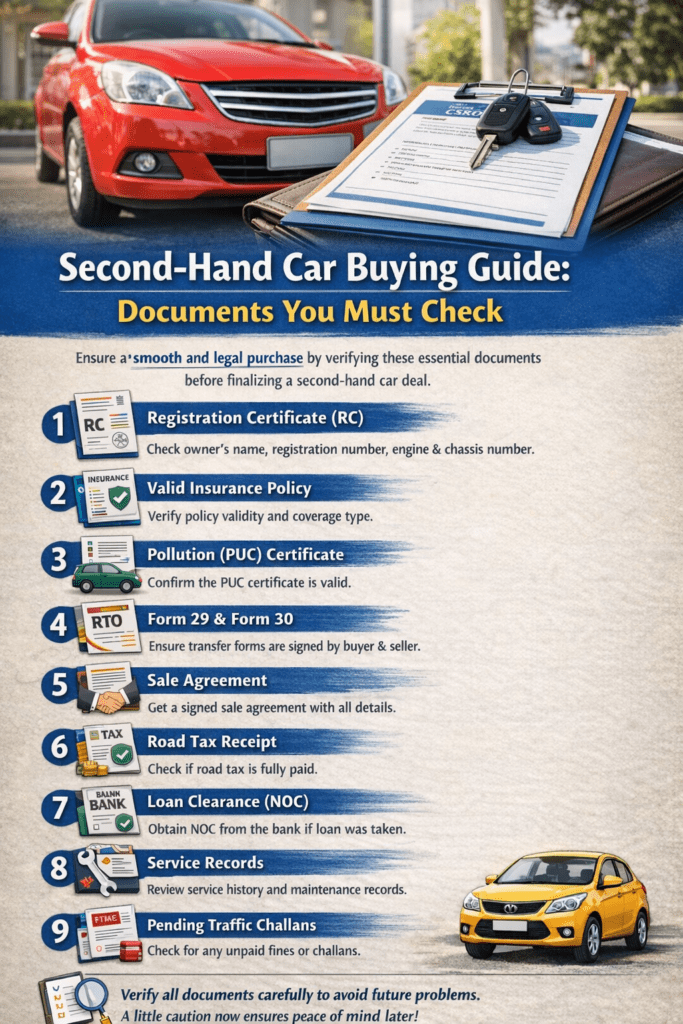
Second-Hand Car Buying Guide: Documents You Must Check
Buying a second-hand car is a smart way to save money while still getting a reliable vehicle. However, many buyers make the mistake of focusing only on the car’s condition and price, ignoring the importance of proper documentation. In India, verifying legal documents is just as important as checking the engine or taking a test drive.
Incomplete or incorrect paperwork can lead to ownership disputes, unpaid fines, hidden loans, or legal complications in the future. To make your purchase safe and hassle-free, here is a complete guide to the documents you must check before finalizing a second-hand car deal.
1. Registration Certificate (RC)
The Registration Certificate (RC) is the most important document of the vehicle. It proves legal ownership and contains key details such as:
- Owner’s name
- Registration number
- Engine number
- Chassis number
- Fuel type
- Date of registration
Always confirm that the seller’s name matches the name mentioned on the RC. Check that the engine and chassis numbers on the car match the numbers printed on the RC. If the vehicle has had multiple owners, verify the ownership history carefully.
2. Valid Motor Insurance Policy
Every vehicle on Indian roads must have valid motor insurance. Ask for the latest insurance policy and check:
- Policy validity date
- Type of coverage (Third-party or Comprehensive)
- Claim history
- No Claim Bonus (NCB) details
After purchasing the car, immediately apply for insurance transfer in your name. Driving without proper insurance transfer can create legal and financial risks.
3. Pollution Under Control (PUC) Certificate
The PUC certificate confirms that the vehicle meets government emission standards. It is mandatory to carry while driving. Ensure the certificate is valid and not expired at the time of purchase.
4. Form 29 and Form 30
These forms are essential for ownership transfer at the Regional Transport Office (RTO).
- Form 29 – Notice of transfer of ownership
- Form 30 – Application for transfer of ownership
Both buyer and seller must sign these forms. Submitting them to the RTO ensures the vehicle is legally transferred to your name. Without proper transfer, the car may legally remain in the previous owner’s name.
5. Sale Agreement
A written sale agreement is highly recommended. It should clearly mention:
- Complete vehicle details
- Agreed sale price
- Date of sale
- Buyer and seller information
- Signatures of both parties
This document acts as proof of transaction and protects both sides in case of disputes.
6. Road Tax Receipt
Check whether the road tax has been fully paid. If the vehicle is registered in another state, re-registration may be required. Clarify this before completing the deal to avoid additional charges later.
7. Loan Clearance Certificate (Bank NOC)
If the car was purchased on finance, confirm that the loan has been fully repaid. Ask for a No Objection Certificate (NOC) from the bank. Never buy a car with an active loan, as it may cause ownership issues.
8. Service and Maintenance Records
Although not legally mandatory, service history is extremely important. It helps you understand:
- How regularly the car was serviced
- Whether major repairs were done
- Overall vehicle condition
A car with proper service records is usually more reliable and well-maintained.
9. Check for Pending Traffic Challans
Before making the final payment, check online for any pending traffic fines linked to the vehicle. Ensure all challans are cleared before ownership transfer.
Final Thoughts
Buying a second-hand car can be a great investment if you take the right precautions. Verifying all documents ensures legal ownership, financial safety, and peace of mind.
Take your time, review every document carefully, and complete the ownership transfer process without delay. A well-documented purchase today will help you enjoy your vehicle confidently for years to come.